I had never heard of Penang until we started talking about going to Malaysia. We were in Cambodia, and considering making a stop in Malaysia–primarily to eat–before heading to Singapore. I dove deep into research on the island off of mainland Malaysia that is incredibly rich in heritage, culture, and food, and was immediately drawn to George Town, its historical heart and Penang state’s capital city.
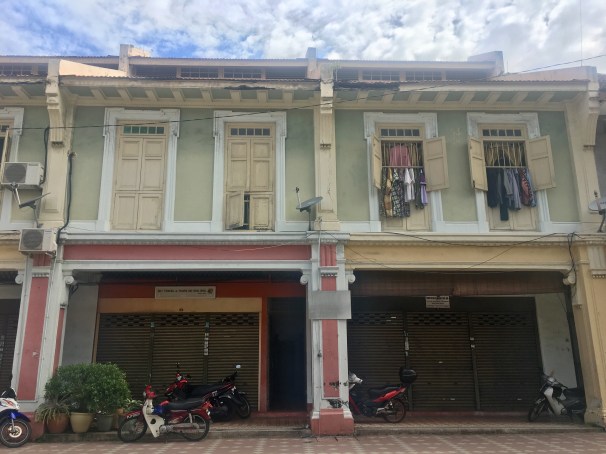
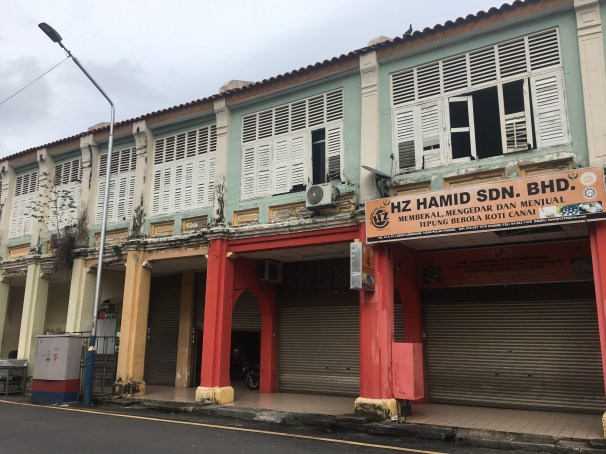
George Town’s charm is endless. After the bus ride from Kuala Lumpur and a ferry from the bus terminal in Butterworth across the Malacca Strait to George Town, I was immediately struck by how colorful and vibrant the streets are. A mixture of clan houses, colonial-era architecture, religious temples, and colorful shophouses date back to the 19th and 20th centuries, and nearly every street carries a visual indication of Penang’s unique past as Southeast Asia’s first British settlement. As a free port, immigrants flocked to George Town from China, India, and Armenia, bringing along their own customs, food, and religions–only adding to the unique Peranakan culture in Malaysia. Now a UNESCO World Heritage-protected area, the streets of George Town transport you back in time in the best way.

But George Town is also–unexpectedly–a city filled with, and known for its, street art. The city invested in making street art one of its main tourist draws after its UNESCO designation and it has really paid off. Capturing the culture and history of Penang, and the spirit and every day lives of its people, the street art we found exploring George Town on foot was captivating, unique, colorful, educational, and interactive. The murals are full of energy and really made me want to learn more. If you do, too, the two best resources I turned to for information on George Town’s street art, which I largely drew upon for this blog post, are: this amazing rundown complete with a map from travel blogger Izzy Pulido of The Next Somewhere, and this great deep-dive on George Town’s street art by Milijana at World Travel Connector.
If you (like me just a few months ago) have never heard of Penang or George Town, you’re in for a real treat! I’ll dive deeper into my favorite parts of this amazing destination–food and coffee, clan houses, jetties, and museums–in soon-to-come posts on Penang. It was one of my favorite destinations that we visited in all of Southeast Asia and I can’t wait to share why.
For now, enjoy this glimpse of my favorite street art found in George Town!
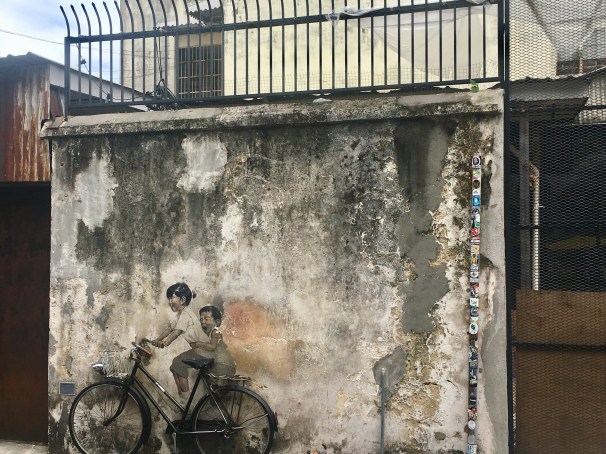
This is the most famous mural in George Town created by Lithuanian-born graffiti artist Ernest Zacharevic, who was hired in 2012 by the Penang Municipal Council to transform the streets into a street art capital of the world. Many of Zacharevic’s murals, like this one with the physical bike jutting out of the wall, are 3D and are meant to invite tourists to interact with them in photo opps. The only drawback: the long lines of tourists waiting to snap pics with this mural. Despite the crowds and the endless photos I had to sit through to get a single one of the mural alone, I love how you can feel the energy of these smiling, laughing kids captured in this mural.

This tiny mural was my favorite that we saw in Penang! A colorful, delightful representation of the main cultures in George Town as told through women’s intricate traditional clothing and headwear. I see this as a celebration of women from different backgrounds coming together. The name of this mural from 2013 is Wo Ai Nee Chinese Malay Indian, which translates to, ‘I love you Chinese, Malay and Indian’.
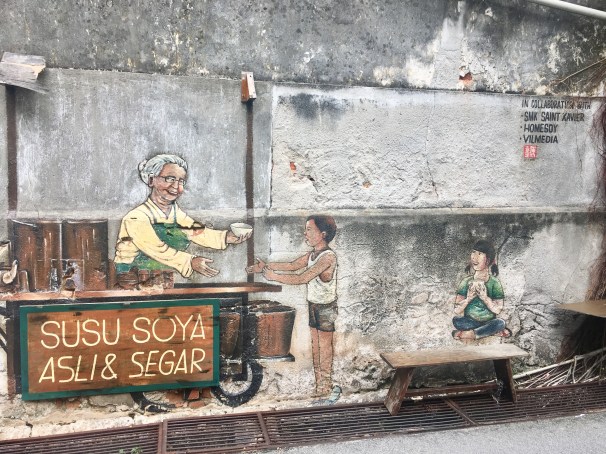
Hidden in an alley off of one of George Town’s main streets, Chulia Street, this lively mural is like an ode to an old soy milk stall that used to dot the streets in Penang.
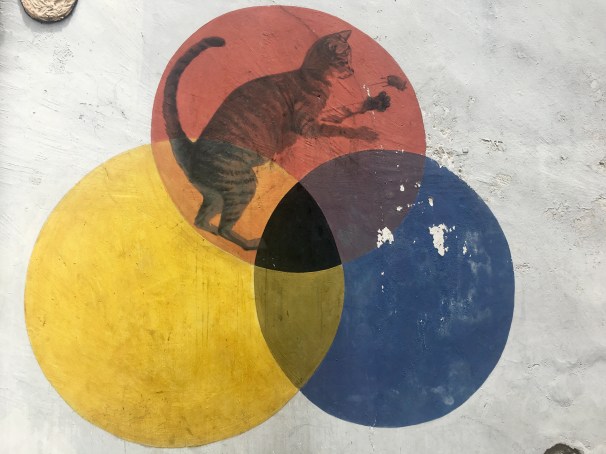
Interestingly, cats are some of the most popular stars of Penang’s street art, largely because of a really amazing artivism project launched here in 2013 by Artists for Stray Animals focused on lost kittens.

I found this gem on a random street in George Town and haven’t been able to pinpoint its artist or origins, but I love the happiness oozing from the young couple portrayed in it and its nods to Zacharevic’s famous mural.

52 of these iron rod sculptures can be found on the streets of George Town, made by “Sculpture at Work” to depict some of the history of Penang. I learned so much from them, and love how they help bring the streets to life. This one, which shows a trishaw driver falling into a hole in the ground, is called “Cannon Hole” and commemorates the infamous 1867 Penang Riots, when coalitions of Chinese secret societies fought over the monopoly of opium and arak farms (fascinating, huh?!). Legend has it a cannon fired during the riots left a hole in the minaret of the Acheen Street mosque–and a hole still remains.

This mural, painted on the wall in the garden of the Cheah Kongsi clanhouse and temple, is aptly titled “Cats and Humans Happily Living Together” and was also part of the lost kitten street artivism project. The cats carry Taoist lanterns and banners as part of a Taoist procession.


 Anna Logs It