It’s late July and pouring, as to be expected during rainy season, and we’ve just crossed the border from Thailand to Laos at Huay Xai, ready to board our two-day slow boat to Luang Prabang. The Mekong River is intimidating, powerful, and a muddy brown color unlike any I’ve seen before.


Climbing on board our long, open-air, wooden boat, the small breeze flowing through is a welcome respite from the hot temperatures we’ve been sweating through in Thailand. It looks like seats have been lifted from the back of old cars and SUVs to line the interior of the boat in varying states of use and upholstery, and placed in just enough disarray to mean differing amounts of personal space and legroom. After we take our seats, the endless flow of additional passengers–tourists and locals–and luggage and goods seems impossible to fit on the boat but we somehow manage with every seat filled and each inch of floor space at the very back of the boat claimed. Just as we’re about to leave, two stragglers run on with bizarre luggage in tow (one man had two grills in boxes, for example) and assuming they somehow manage to make space for themselves (and the grills), the engine roars and we’re moving.


As soon as we disembark, I start to see what the muddy brown color of the water is hiding. The Mekong from afar is a massive powerfully flowing river. But up-close, it is a maze of rapids and tidepools. The boat captain immediately finds his rhythm jeering the steering wheel from left to right to navigate around strong rapids, and to avoid slamming into jagged rocks and formations that jut up suddenly at random points. Looking constantly from one side to the other, I’m overwhelmed trying to take in all of the scenery, the shades of lush greens, dense jungle trees, and mountains and hills surrounding us.


A couple of hours in, the slow boat ride feels relaxing and easy. The captain and crew’s movements are effortless as our boat follows the strong river flow. The hours fly by reading, observing our surroundings, and watching each time we start to head toward the tiniest of ports and towns dotting the riverbank to collect or drop off people or goods.
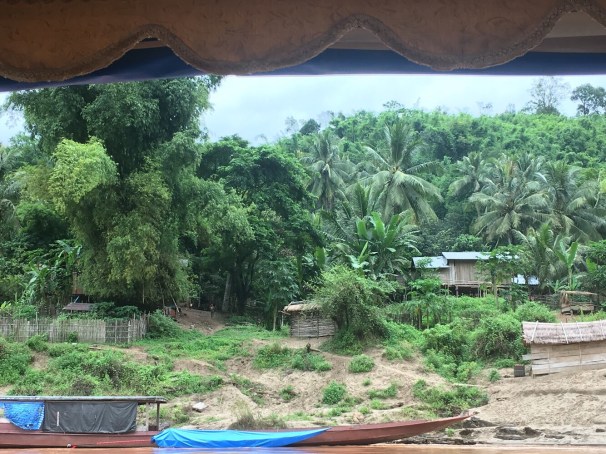
Countless stops looked like this.
After docking in Pakbeng for the night, we fall asleep in our comfortable hotel to the sounds of the Mekong–like a jungle symphony. A little over twelve hours and one great nights sleep later, we’re back on the boat in less comfortable seats unfortunately, pulling away from Pakbeng at 9 am. The second day passes much like the first: relaxing and serene, full of incredible views, lots of reading, a few podcasts, and a couple crosswords.
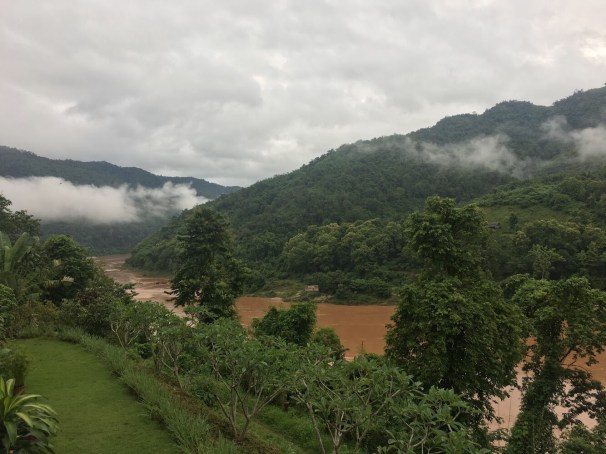
View overlooking the Mekong from our hotel in Pakbeng.
Around 5 pm, we start to see the Luang Prabang slow boat pier in the distance growing closer and just like that, our time on the Mekong is over.
Travel Tips: Given our travels through Southeast Asia meant many interactions with the Mekong River – the seventh largest river in Asia – in Laos, Vietnam, and Cambodia, it felt only fitting to jump at the chance to spend two days on it to journey from Thailand to Laos. The two-day slow boat from Huay Xai to Luang Prabang is such a unique experience and one I would highly recommend if you have the time to spare in your travels from Thailand to Laos. It takes three full days: one day for an 8 hour bus trip (including a stop at the mind-boggling ‘White Temple’ in Chiang Rai) from Chiang Mai to ChiangKhong, just across the Mekong from Huay Xai where you spend the first night, then the two days for the border crossing and slow boat. It’s relatively cheap (far less than a flight from Chiang Mai to Luang Prabang) and far more fun than being crammed on a bus for several hours. We found a travel agency in Chiang Mai called Travel Hub Tours and stopped by their offices just near the Tha Phae Gate to get pricing and book the day before we wanted to leave. It was easy, cheap, and they made the process fairly simple to follow until we boarded the slow boat and you’re on your own.

Wat Rong Khun, the ‘White Temple’, in Chiang Rai.
 Anna Logs It